
English| EUR
Suggested for you
More currencies
Choose a language
Kailua-Kona hosts one of the few reliable manta ray night snorkel sites on earth, and the answer to where is narrower than most visitors expect. Two harbours send boats out; the rays gather at a small number of lit plankton stations offshore. This page sets out the departure points, the hours that matter, and the conditions that decide whether the animals show.
Quick answer
Boats depart from Keauhou Bay and Honokohau Harbor, Kailua-Kona, HI — the two access points for Kona's manta night snorkel sites. The ocean itself is free at 0 USD, but the sites sit offshore and require a commercial tour boat for access. Aim to arrive between 17:30 and 20:30, the window that delivers optimal darkness and conditions for night feeding activity.
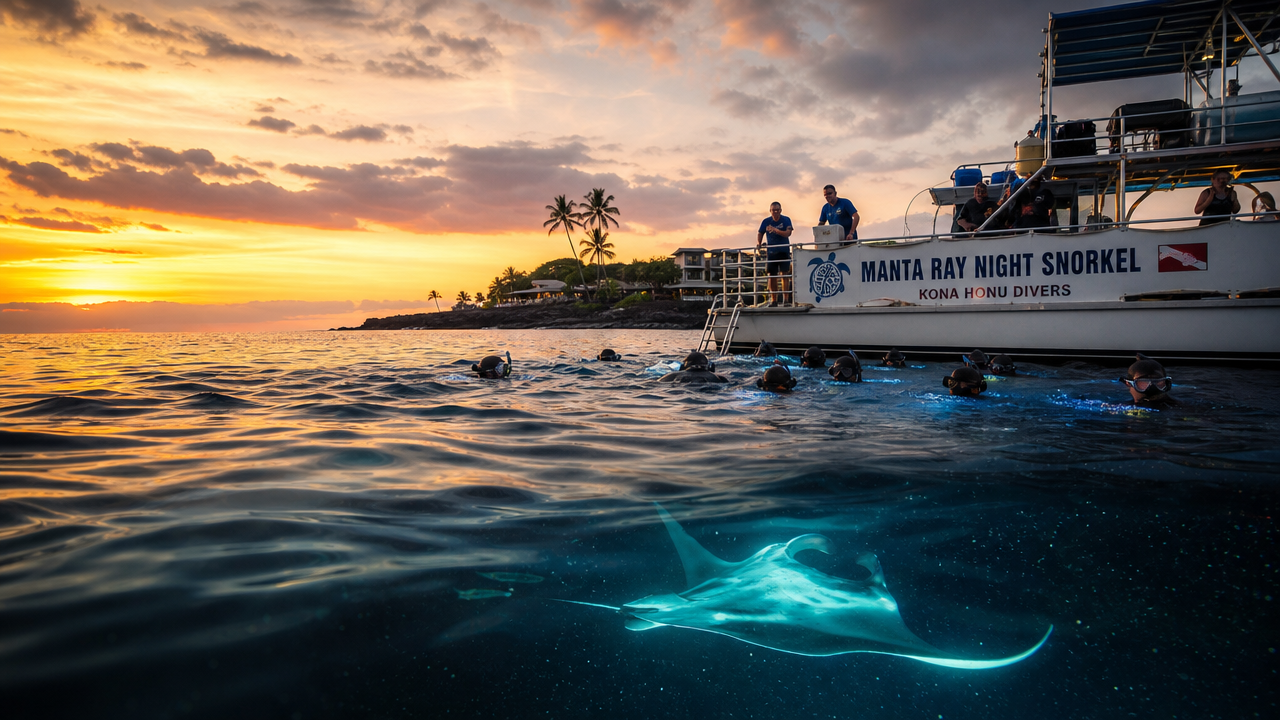
Manta rays do not have teeth. The animals gliding beneath Kona snorkelers are filter feeders, straining zooplankton through gill rakers while looping in slow backward somersaults, and they can pass within inches of a floating swimmer without any risk of a bite. That biology explains the entire encounter: the rays are not drawn to people, they are drawn to plankton, and plankton is drawn to light. Every reliable manta viewing site on this coast is a lit patch of water above a shallow sand-and-reef bottom. So the practical question of where can i snorkel with manta rays resolves into a short list. The Keauhou Bay site — often called Manta Village, off the Sheraton coastline — and the Garden Eel Cove area near Kona International Airport, reached from Honokohau Harbor, are the two anchor points. Neither is a shore entry. Both sit offshore over deep water, which is why access runs through a commercial operator with a boat, floats and downward-facing lights. Visitors searching for a Kona manta ray night snorkel or a Big Island manta tour will find those two names attached to nearly every listing, and the choice between them usually comes down to which harbour is closer to their accommodation and how the surface conditions read on the day. The mechanics are worth understanding before booking. Operators cluster their light arrays after sunset; the plankton bloom builds over the following hour; the mantas arrive to feed and often stay for the duration of the water time. Snorkelers hold a floating light board face-down and stay still, letting the animals control the distance. Photographers should expect low light and constant motion. Sightings are high but never guaranteed — this is wild behaviour on a wild reef, and swell, moon phase and current all shift the odds. Use this page as the frame, then follow the site's dedicated sections for the detail: the hours panel for the daily schedule, the pricing section for what operators charge, the getting-there notes for harbour parking, and the checklist for what to bring. The short version of where can i snorkel with manta rays guide advice is this — pick Keauhou or Honokohau, book a boat, and build the evening around darkness rather than daylight.
“The rays are not drawn to people, they are drawn to plankton, and plankton is drawn to light.”
The best arrival window for snorkeling with manta rays is 17:30–20:30, as this timeframe provides the optimal darkness and conditions required for night feeding activity. Manta rays frequent these coastal waters to feed on plankton, which aggregate near light sources provided by tour vessels after sunset.
Warm waters near 80°F
Manta activity remains consistent throughout the warmer months.
Cooler waters near 75°F
Ray sightings are frequent despite occasional winter swells.
Mild temperatures near 77°F
April and October often provide stable sea conditions for night operations.
Verdict: The best time to visit is during the shoulder months of April or October, arriving within the 17:30–20:30 window to match peak feeding activity.
The ocean waters in Kailua-Kona remain accessible at all hours, though specific night snorkeling activity is dependent on commercial tour boat schedules.
Access to the manta ray feeding grounds in Kailua-Kona is free as the ocean is a public resource. However, reaching the designated snorkeling sites safely requires booking a commercial tour boat.
Verdict: While the ocean itself is free, individuals must pay for a commercial boat tour to access these specific sites.
Manta ray snorkeling excursions depart from two primary locations in Kailua-Kona: Keauhou Bay to the south and Honokohau Harbor to the north. Visitors should verify their specific departure point with their tour operator as both locations are accessible via Highway 11 and Highway 19.
Highway 11 to Kaleiopapa Street for Keauhou Bay
Highway 19 to Kealakehe Parkway for Honokohau Harbor
Direct service to Keauhou Bay or Honokohau Harbor
Parking at both harbors is limited during evening hours. Aim to arrive at the designated meeting point at the best arrival window of 17:30–20:30 to ensure sufficient time for parking and check-in.
Manta ray night snorkels run from commercial boats leaving Keauhou Bay and Honokohau Harbor, so most of the preparation happens well before you reach the water.
Manta rays at Kona's night sites are wild animals feeding on plankton drawn to the boats' lights, and the encounter depends entirely on divers and snorkelers holding position without interfering. Manta Ray Green List standards followed by Keauhou Bay and Honokohau Harbor operators are built around one principle: the mantas approach you, never the reverse.
Everything you need to know about where can i snorkel with manta rays
You can experience these encounters at Keauhou Bay and Honokohau Harbor, which serve as the primary departure points for Kona manta ray night snorkel tours. These locations provide reliable access to areas where rays congregate to feed on plankton. Many visitors ask where can i snorkel with manta rays to ensure they choose the right departure site. Planning your trip around these specific harbors is essential for a successful outing.
Yes, you must book a commercial tour boat to reach the active feeding sites safely. Local operators provide the necessary gear, boat transport, and professional supervision required for this activity. When considering where can i snorkel with manta rays, remember that private boat access is required to reach the deeper offshore waters. These tours ensure you have the proper safety equipment for swimming in dark conditions.
The optimal arrival window is 17:30–20:30, as this period offers the best darkness for night feeding activity. This time frame allows the rays to congregate in the illuminated areas beneath your snorkel site. If you are wondering where can i snorkel with manta rays during your vacation, prioritizing these evening hours is key to seeing the most marine life. Always check your tour confirmation for the specific boarding time assigned to your excursion.
Most operators welcome participants of various ages, but swimming ability and comfort in the water are primary requirements. Each company maintains its own specific policies regarding young swimmers and non-swimmers. Please verify these details with your chosen tour provider before confirming your reservation.
Manta rays are gentle filter feeders, and thousands of people safely enjoy these encounters every year. Following the instructions provided by your tour crew ensures both your safety and the protection of the animals. While searching for where can i snorkel with manta rays, prioritize companies that emphasize responsible wildlife interaction practices. Keeping your distance and following group protocols helps maintain a calm environment for everyone.
The ocean itself has an entry fee of 0 USD, meaning there is no cost for the water access. However, you must utilize a commercial boat service to reach the viewing sites, which requires purchasing a seat on a professional tour. While the ocean is free, the logistics of a boat charter are necessary for this specific experience.
Bring a towel, a warm cover-up, and any personal snorkeling gear if you prefer not to use rental equipment. Most tour companies provide high-quality masks, snorkels, fins, and flotation devices as part of their service. Pack light, as space on tour boats is often limited.
Small Group Snorkel Adventures
Read more GuideManta Ray Snorkel Photos
Read more Tickets & toursGuided Manta Ray Snorkel Tours
Read more Tickets & toursBig Island Manta Ray Night Snorkel
Read more Tickets & toursKeauhou Harbor Manta Ray Snorkel
Read more GuideKona Manta Ray Snorkel Prices
Read more